
Comprehensive Guide to OSD Granulation by Kavs Spectech Pvt Ltd
Oral Solid Dosage (OSD) forms, such as tablets and capsules, are the most prevalent methods of drug delivery in the pharmaceutical industry. The granulation process is pivotal in transforming active pharmaceutical ingredients (APIs) and excipients into a cohesive, uniform mixture suitable for compression or encapsulation. Granulation enhances the flowability, compressibility, and dissolution properties of the final dosage form, ensuring consistent drug release and efficacy.
Spectro Kavs: A Leader in Pharmaceutical Equipment Manufacturing
Spectro Kavs, a dynamic engineering firm, specializes in providing turnkey solutions for pharmaceutical manufacturing. With a team comprising engineers, designers, and IITians, the company focuses on delivering high-end B2B projects tailored to meet international standards. Their expertise spans cleanroom setups, HVAC systems, laboratory design, and specialized equipment for OSD granulation.
OSD Granulation Equipment Offered by Spectro Kavs
Spectro Kavs offers a comprehensive range of equipment designed to optimize the granulation process, ensuring high-quality OSD products:
1. Wet Granulation Equipment
-
-
- Rapid Mixer Granulators (RMG): These devices facilitate the efficient mixing of powders with a granulating liquid, forming a wet mass that is subsequently dried. RMGs are essential for producing granules with uniform size and density.
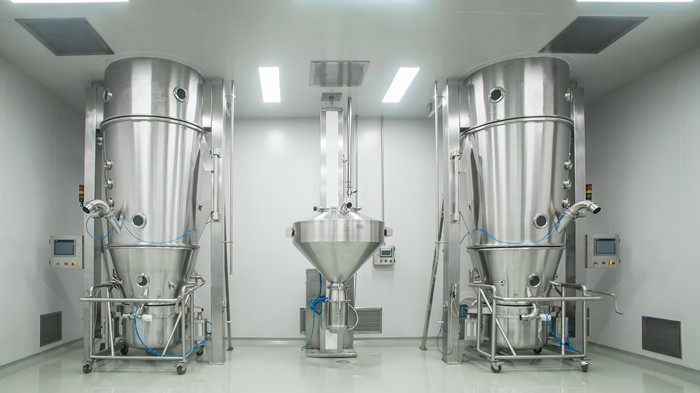
- Fluid Bed Dryers (FBD): After granulation, the wet granules are dried using FBDs, which employ hot air to remove moisture, yielding dry granules suitable for compression.
- Multi Mills and Shifters: These are used for size reduction and classification of granules, ensuring uniform particle size distribution.
- Tablet Compression Machines: These machines compress the dried granules into tablets, applying precise pressure to achieve the desired tablet hardness and weight.
- Tablet Coating Systems: Post-compression, tablets are coated to enhance stability, mask taste, and control drug release.
-
2. Dry Granulation Equipment
-
-
- Roll Compactors: These machines compress powder blends into sheets, which are then milled to produce granules. Dry granulation is ideal for heat-sensitive materials that cannot undergo wet granulation.
- Blenders: Used for uniform mixing of powders before the granulation process, ensuring consistent composition.
- Multi Mills and Shifters: Similar to their role in wet granulation, these devices are used for size reduction and classification in dry granulation.
- Tablet Compression Machines and Coating Systems: As in wet granulation, these are used to form and coat tablets from the granules produced by dry granulation.
-
Advantages of Spectro Kavs’ OSD Granulation Equipment
- Customization: Equipment can be tailored to meet specific production requirements, accommodating various batch sizes and formulations.
- Efficiency: Advanced technology ensures optimal processing times, reducing production costs and enhancing throughput.
- Compliance: Equipment is designed to meet international regulatory standards, ensuring quality and safety.
- Integration: Systems are compatible with existing production lines, facilitating seamless upgrades and expansions.
The Granulation Process: A Step-by-Step Overview
- Weighing and Mixing: Accurate weighing of APIs and excipients is followed by thorough mixing to achieve a homogeneous blend.
- Granulation: Depending on the formulation, either wet or dry granulation techniques are employed to form granules.
- Drying: Wet granules are dried using FBDs to remove moisture content, ensuring stability and preventing microbial growth.
- Size Reduction and Classification: Granules are milled and sifted to achieve the desired particle size distribution.
- Compression: The granules are compressed into tablets using tablet compression machines.
- Coating: Tablets are coated to protect the API, control release, and improve appearance.
Quality Control and Assurance
Spectro Kavs emphasizes the importance of quality control throughout the granulation process. Their equipment is designed to facilitate:
-
-
- In-Process Monitoring: Real-time monitoring of critical parameters such as temperature, humidity, and pressure.
- Batch Documentation: Comprehensive documentation to support traceability and compliance with Good Manufacturing Practices (GMP).
- Validation Support: Assistance in validating equipment and processes to meet regulatory requirements.
-
Comprehensive Guide to OSD Granulation Global Reach and Clientele
With international offices in Portugal, Egypt, Dubai, and the USA, Spectro Kavs serves a diverse clientele across the globe. Their commitment to quality and innovation has earned them trust among leading pharmaceutical companies.
Spectro Kavs stands at the forefront of pharmaceutical equipment manufacturing, offering state-of-the-art OSD granulation solutions that enhance product quality and production efficiency. Their expertise, coupled with a commitment to excellence, makes them a preferred partner for pharmaceutical manufacturers worldwide.
#SpectroKavs #OSDGranulation #PharmaceuticalEquipment #GranulationProcess #TabletManufacturing #PharmaInnovation #CleanroomSolutions #PharmaceuticalEngineering #GMPCompliance #TabletCoating #RapidMixerGranulator #FluidBedDryer #DryGranulation #PharmaManufacturing #InternationalPharma #PharmaceuticalIndustry #GranulationEquipment #PharmaTechnology #PharmaceuticalDesign #SpectroKavsInnovation #PharmaSolutions #TabletCompression #PharmaManufacturingEquipment #PharmaceuticalSolutions #GranulationMachinery #PharmaEquipmentManufacturing #SpectroKavsGlobal #PharmaceuticalTurnkeySolutions #PharmaProcessOptimization #OSDManufacturing
- Website
- About Us
- Services
- Projects
- Careers
- Contact Us
- Clean Room Panels
- Stainless Steel Furniture
- Bsl Laboratories – III & IV
- Unidirectional Air Flow
- Design & Consultancy
- Cleanroom Equipments
- HVAC SYSTEMS
- OSD-GRANULATION MACHINERIES
- INJECTABLE LINE (VIAL/AMPOULE/PFS)
- PROCESS SOLUTIONS
- MODULAR OPERATION THEATRE
- PROJECT MANAGEMENT & DESIGN CONSULTANCY
- ISOLATION TECHNOLOGY
- HOSPITAL – HEALTHCARE FACILITIES
- MOBILE LOCKER COMPACTOR
- Clients
- Business Associates
Comprehensive Guide to OSD Granulation
Oral Solid Dosage (OSD) manufacturing relies heavily on efficient and precise granulation steps. In this Comprehensive Guide to OSD Granulation, you’ll learn:
Key stages of the OSD granulation process
Comparison of pharmaceutical granulation techniques
Benefits and challenges of wet granulation for OSD
Critical considerations when choosing granulation equipment in pharma
Let’s begin.
1. Fundamentals of the Granulation Process
Granulation transforms fine powders into larger, free‑flowing granules. This improves:
Flowability – essential for tablet press efficiency
Uniformity – ensures dose consistency in each tablet
Compressibility – critical for forming solid tablets
In the OSD granulation process, the main objectives include minimizing dust, ensuring mixture homogeneity, and improving physical properties.
2. Pre-Granulation Step – Blending & Binder Addition
It begins with dry blending, mixing active ingredients with excipients like fillers and disintegrants. Binder solutions may be added briefly. Ensuring even distribution of the binder is key, as this supports pharmaceutical granulation techniques moving forward.
3. Wet Granulation for OSD: Key Method
Wet granulation for OSD remains the dominant method—especially when active pharmaceutical ingredients (APIs) require enhanced dissolution or flow properties.
Binder solution sprayed or added to powder blend
Shear or fluid-bed granulation used to form granules
Granules dried, milled, and sized to optimal dimensions
This method enhances compressibility and ensures robust tablet integrity.
4. Dry Granulation: Roller Compaction & Slugging
Alternatives to wet techniques, pharmaceutical granulation techniques also include:
Dry granulation—roller compaction creates ribbons that are milled into granules
Slugging—tableting coarse agglomerates, then milling
Dry granulation is advantageous for moisture-sensitive APIs and eliminates drying steps.
5. Spray Drying and Melt Granulation
Other advanced techniques:
Spray drying: spray suspension/liquid into hot chamber, producing fine granules
Melt granulation: uses molten binders instead of solvents—ideal for heat-stable formulations
Each method has pros and cons depending on API properties and scale.
6. Choosing Granulation Equipment in Pharma
Selecting the right machinery involves understanding:
High-shear mixers – suitable for wet granulation with tight process control
Fluid bed granulators – ideal for drying and granule coating
Roller compactors – for dry granulation without solvents
Spray dryers and melt granulators – for specialized processing
Key criteria include batch size, solvent management, process control, and cleaning protocols.
7. Process Parameters Impacting Granule Quality
Critical variables include:
Binder concentration and addition rate
Granulator speed and torque
Impeller/blade configuration
Moisture level and drying time
Final particle size from milling
Precision in these parameters ensures consistent granule flow and tablet uniformity.
8. In-Process Monitoring & Quality Control
Quality must be ensured at multiple stages:
Moisture content—using moisture analyzers
Granule size distribution—via laser diffraction or sieving
Density and flow metrics
Tablet performance tests: hardness, disintegration, assay
These control checks guarantee adherence to quality standards.
9. Scale-Up: Lab to Commercial Production
What works at lab scale may not translate directly to production. Scale-up considerations include:
Processor geometry and mechanical energy scaling
Heat and mass transfer consistency
Granulation kinetics and power input levels
Pilot studies are essential to ensure reproducibility during commercial scale.
10. Regulatory & GMP Compliance
Granulation systems must comply with:
Current Good Manufacturing Practices (cGMP)
Regulatory filings: including all process parameters and controls
Cleaning validation to avoid cross-contamination
Thoroughly documented Standard Operating Procedures (SOPs)
Adherence safeguards product quality and regulatory approval.
11. Cost vs. Benefit Comparison
When selecting between methods:
Wet granulation: better compression, more complex & expensive
Dry granulation: simpler & cost-effective, but may yield lower tablet density
Melt granulation: no solvent usage, but high energy costs
Spray drying: great for fine powders but high capital investment
Cost-benefit analysis must align with product goals and timelines.
12. Emerging Innovations
Recent advancements include:
Continuous granulation—steady-state twin-screw systems
Real-time PAT markers—controlled via predictive analytics
Solvent-free binders, eco-friendly processing
Advanced coating-integrated granulation systems
These trends are refining the OSD granulation process for better efficiency and sustainability.
13. Case Study Highlights
Example 1: A dry granulation line introduced roller compaction, cutting moisture issues and doubling batch sizes.
Example 2: A wet granulation update using granular PAT sensors improved tablet weight uniformity by 25%.
Example 3: Adoption of continuous twin-screw granulation halved cycle times and saved solvent costs.
14. FAQs
Q: When is wet granulation preferred?
Ideal when formulation needs enhanced compressibility and moisture control.
Q: Is roller compaction suitable for all APIs?
It works best for APIs tolerant to mechanical stress and when avoiding solvent use is essential.
Q: How is granule quality monitored in-process?
Through moisture, size distribution, and flowability analysis.
Q: Which equipment minimizes cleaning downtime?
Fluid bed and twin-screw systems designed with easy-clean interiors.
15. Final Takeaway
The success of any solid dosage form hinges on a well‑managed granulation approach. Whether you choose wet granulation for OSD, dry granulation, or advanced techniques, understanding each step ensures optimal product stability, functionality, and compliance.
When selecting granulation equipment in pharma, consider scale, process specifics, and regulatory demands. With robust planning and quality systems, your OSD lines can deliver consistent, world‑class medication for patients everywhere.
16. Validation and Documentation Best Practices
Every stage of the OSD granulation process must be thoroughly validated to comply with regulatory standards:
Installation Qualification (IQ): Verify equipment is installed per specifications.
Operational Qualification (OQ): Confirm machines perform consistently under defined operating parameters.
Performance Qualification (PQ): Validate the entire system produces quality granules across multiple batches.
Maintaining Standard Operating Procedures (SOPs) for each granulation step (blending, granulating, drying, milling) is critical. Additionally, batch records should capture key process parameters such as granulation time, temperature, moisture levels, and equipment speed to ensure traceability and reproducibility.
17. Troubleshooting Common Granulation Issues
a) Over-Wetted Granules
Signs: Sticky granules, slow drying.
Fix: Reduce binder concentration or spray rate; increase drying time or inlet air temperature.
b) Under-Bound Granules
Signs: Powdery lumps, poor flow.
Fix: Increase binder strength or add another binder addition cycle.
c) Inconsistent Granule Size
Signs: Broad size variation post-milling.
Fix: Adjust impeller speed, granulator shear time, or recalibrate milling equipment.
d) Blow-By in Roller Compaction
Signs: Poor compaction, dust in granules.
Fix: Optimize roll gaps, feeder speed, and compactor roll pressure.
e) Variations in Tablet Hardness
Signs: Soft or hard tablets inconsistent across batches.
Fix: Stabilize granule moisture and milling conditions, and ensure consistent compression settings.
18. Continuous Granulation & Industry 4.0
Continuous granulation is reshaping production efficiency:
Uses twin-screw or single-screw feeders and inline drying.
Allows true real-time monitoring of granule moisture and size.
Reduces batch-to-batch variation and equipment footprint.
Offers increased flexibility—quick changeovers and scalable throughput.
Industry 4.0 initiatives combining granulation equipment in pharma with AI-enabled predictive control establish superior resilience and productivity.
19. Scalability and Capacity Expansion
Scaling requires careful consideration:
Match granulator dimensions and impeller speeds for geometric similarity.
Maintain consistent specific mechanical energy (SME) across scales.
Evaluate residence time across wet-to-dry zones—use tracer or dye methods.
Align milling force and speed so particle size distribution is consistent.
Whenever possible, conduct pilot runs at scaled-down levels to verify adjustments before full-scale implementation.
20. Sustainability & Green Manufacturing
Emerging green strategies include:
Investing in solvent-free granulation techniques like melt granulation.
Using recycled heat recovery systems and economizers during drying.
Implementing energy dashboards to track kilowatt usage per kilogram of granules.
Transitioning to bio-based or biodegradable binders and lubricants.
These measures enhance factory sustainability while reducing operating costs and regulatory exposure.
21. Supply Chain & Vendor Relationships
Secure raw materials and support through:
Vendor-qualified excipient grade selection with Certificate of Analysis (CoA).
Calibration of incoming binder suppliers for viscosity and impurity control.
Ongoing performance monitoring and supplier audits.
Establishing partnerships with equipment manufacturers for ongoing support and upgrades.
Strong vendor relationships ensure process consistency and allow early adoption of new technologies.
22. Employee Training and Skill Building
Personnel competency is essential for GMP-compliant systems:
Provide hands-on training on wet granulators, dryers, and milling assemblies.
Educate staff on interpreting in-line analytics like NIR moisture sensors.
Conduct periodic assessments of cleaning and operation logs.
Promote a culture of continuous improvement—encourage personnel feedback on anomalies.
An empowered workforce enhances operational excellence and reduces validation errors.
23. Future Outlook: Nanograns and Smart Coatings
Looking ahead:
Nanograns: 100–500 µm particle size systems delivering rapid drug dissolution.
Smart coatings: Enable targeted or extended-release formulations built right into the granule.
3D-printed granules: Custom release patterns and geometries for complex dosing.
AI-powered control loops: Real-time adaptation of granulation parameters to maintain granule specs under variable loads.
Adoption of these innovations early can place your production at the cutting edge of pharmaceuticals.
24. Summary & Strategic Takeaways
Robust validation, clear SOPs, and consistent documentation are foundational.
Troubleshooting common granulation problems enhances yield and quality.
Transition to continuous and sustainable granulation aligns with future industry trends.
Skilled workforce, strong supplier relations, and a forward-thinking mindset yield long-term success.
By mastering these advanced principles and embracing innovation, your facility can ensure repeatable, scalable, and compliant output—paving the way for market differentiators built on quality and efficiency.
OSD Granulation
OSD Granulation
Understanding OSD Granulation: Techniques, Processes, and Equipment in Pharmaceutical Manufacturing
Oral Solid Dosage (OSD) forms such as tablets and capsules represent the most common drug delivery systems in the pharmaceutical industry. A critical step in the production of these dosage forms is OSD granulation, a process designed to improve powder flow, compressibility, and uniformity. This blog will explore the OSD granulation process, highlight various pharmaceutical granulation techniques, dive deeper into wet granulation for OSD, and discuss essential granulation equipment in pharma manufacturing.
What is OSD Granulation?
OSD granulation is a vital manufacturing step where fine powders are aggregated into larger, multi-particle entities called granules. This enhances the physical properties of powders to make them suitable for downstream processing like tablet compression or capsule filling.
The granulation process helps overcome challenges such as:
Poor flowability of powders
Segregation of drug and excipients
Low bulk density causing handling difficulties
Uneven content uniformity in final dosage form
By converting fine powders into granules, pharmaceutical manufacturers achieve better process efficiency, dosage accuracy, and product quality.
The OSD Granulation Process Explained
The OSD granulation process typically involves the following stages:
Mixing of Ingredients: Active pharmaceutical ingredients (APIs) and excipients are blended to ensure homogeneity.
Binder Addition: A liquid binder is added to the powder mix to facilitate particle adhesion.
Granule Formation: Under mechanical force or agitation, powders aggregate into granules.
Drying: Wet granules are dried to reduce moisture content to optimal levels.
Sizing and Screening: Dried granules are sized by milling or screening to ensure uniformity.
Final Blending: Additional excipients such as lubricants are blended before compression or encapsulation.
Each stage plays a critical role in determining the quality attributes of the granules and the final oral solid dosage form.
Pharmaceutical Granulation Techniques
Several pharmaceutical granulation techniques are employed depending on the formulation and process requirements. The most common methods include:
1. Wet Granulation
Wet granulation is the most widely used technique where a liquid binder solution is sprayed or mixed with powders to form granules. This method improves binding and enhances powder flow and compressibility. It is especially useful for poorly compressible APIs.
2. Dry Granulation
Dry granulation involves compacting powders under pressure without using any liquid binder. Roller compaction or slugging is used to form dense sheets or compacts that are milled into granules. It is suitable for moisture-sensitive materials.
3. Melt Granulation
In melt granulation, a binder that melts at low temperatures is added to the powders. Upon cooling, the binder solidifies, forming granules without the need for drying. This technique is gaining popularity for heat-sensitive drugs.
4. Spray Drying
Spray drying involves atomizing a solution or slurry into a hot chamber where rapid drying forms granules or powders. It is mainly used for producing highly uniform and fine granules.
Wet Granulation for OSD: A Closer Look
Among the pharmaceutical granulation techniques, wet granulation for OSD remains the most common due to its versatility and effectiveness. This process enhances particle bonding through the use of liquid binders, resulting in granules with improved flow and compressibility.
Advantages of Wet Granulation:
Produces granules with uniform size and density
Improves content uniformity of APIs
Enhances compressibility, reducing tablet defects
Allows for incorporation of moisture-sensitive drugs with controlled drying
Critical Parameters in Wet Granulation:
Binder type and concentration
Amount and rate of liquid addition
Mixing speed and time
Drying temperature and duration
Optimizing these parameters is crucial to obtain granules with desired properties.
Granulation Equipment in Pharma: Essential Machinery
The success of the granulation process depends heavily on the right granulation equipment in pharma manufacturing. Common equipment includes:
1. High Shear Mixers
These mixers combine powders and binder with high-speed agitation, producing dense and uniform granules. They are ideal for wet granulation.
2. Fluid Bed Granulators
Fluid bed systems spray binder onto powders suspended in a fluidized bed, allowing simultaneous granulation and drying. This equipment offers excellent control over granule size and moisture.
3. Roller Compactors
Used for dry granulation, roller compactors compress powder between rollers to form sheets, which are then milled into granules.
4. Spray Dryers
Spray dryers atomize solutions to produce fine granules or powders with excellent uniformity and solubility characteristics.
5. Sieves and Mills
After drying, granules are passed through sieves and mills to achieve uniform particle size distribution necessary for consistent tablet compression.
Conclusion
OSD granulation is a cornerstone of oral solid dosage manufacturing that significantly impacts the quality and performance of the final pharmaceutical product. By understanding the OSD granulation process and carefully selecting appropriate pharmaceutical granulation techniques like wet granulation for OSD, manufacturers can optimize product uniformity, stability, and manufacturability.
Furthermore, investing in the right granulation equipment in pharma ensures a streamlined process, improved batch consistency, and compliance with stringent industry standards. As the pharmaceutical industry evolves, advanced granulation technologies continue to play a critical role in delivering safe, effective, and high-quality medicines to patients worldwide.
Table of Contents
Toggle