Project Management and Design Consultancy
End-to-end project execution with strategic design insights — delivering compliant, cost-effective, and high-performance solutions from concept to completion.
Project Management & Design Consultancy
Project Scope
An appropriately detailed Work breakdown structure will be developed to ensure the project scope is properly agreed and understood by all stakeholders. This also allows the complete project to be split into appropriate sub- projects and/or phases.
Construct an Initial Plan / Preliminary project plan
Once tasks of an appropriate level have been identified in the WBS, the project team into logical network diagrams, with estimated durations, will organize them. This allows the project manager to predict when activities will be complete, assess the feasibility of target dates, and identify the critical path for the project.
Deliverables : Initial work plan
Add Resources, Costs, and Risks / Commercial estimated Project plan

Certain project resources may be defined as critical resources. In particular, the project manager may suspect that key project staff may be faced with too much work. If so, estimated resource usage information can be added to the project plan to allow resource forecasting. Cost is often also critically important, and expenditures can be added to the plan to create estimated cash-flow requirements. Risk management can also be utilized on projects to provide a framework to better manage events that occur beyond the control of the project team.
Deliverables: Resource availability and commitment profiles, risk identification and control strategies, cash-flow forecasts.
Obtain Stakeholder Buy-in
To ensure the project is implemented as smoothly as possible, with the support of the involved parties, it will be necessary to review the initial plans with all the major project stakeholders, and solicit buy-in from each one. A phase-exit review will be conducted to ensure that the project is ready to move into the next phase.
Deliverables : Approved final plan, phase-exit review checklist.
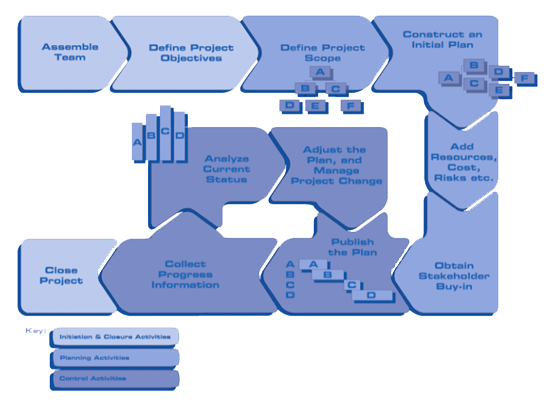
Publish the Plan & design
Once the plans are agreed to, they must be effectively communicated to all stakeholders. This can be done in hard copy or via electronic media, depending on the resources available. On most projects a communications plan will be developed, and distribution of the plans will follow the guidelines laid out in the communications plan.
Deliverables: Plan published to all stakeholders.
Collect Progress Information
- Activities completed within the past two weeks
- Activities forecast for the next two weeks, with a focus on activities on the critical path
- Funds expended vs. fund expenditure forecast
- Prioritized issues report
Metrics can also be developed to measure project progress in other ways, such as earned value, or activity float statistics. If the project manager reviews the progress data and concludes that the project is complete, a phase-exit review will be performed to confirm that all the objectives have been met before moving into the final closure phase.
Deliverables: Set of progress reports, set of exception reports, metrics report, (phase- exit review checklist).
Analyze Current Status
By analyzing the progress information received, the project manager will be able to augment the above reports with information about which areas of the project are of concern, and where problems are likely to occur in the future. This allows managers to focus on the important/critical areas of the project.
Deliverables: Project evaluation report(s).
Adjust the Plan, and Manage Project Change
Based on the analysis, and with the support of the project team, the project manager will make plan adjustments to help reduce risks, accommodate scope changes, or to compensate for activities that have not occurred on schedule. Once this has happened, the plan will re-published, and the cycle repeated until the project is complete.
Deliverables: Change request forms, updated plan.
Close Project
When the objectives of the project have been achieved, the project manager will close down the project. This will involve some financial closure tasks, as well as archiving of the project materials. A lessons-learned document will be developed to benefit future projects, and if possible a project team celebration will be held.
Deliverables: Change request forms, updated plan.
Stage 1: Initiation
Once you’ve got all your tools lined up, you’re ready to start planning your project cycle.
First up, it’s the initiation phase. This is where you work out your project’s reason for existing.
- Sterility Testing
- What is Client requirement, process.
- Feasibility study
- Scope of work and major deliverables.
- You may want to map out some SMART goals to organize structure.
- Many projects also require investment — resource commitments on financial supports or stake holders— so you’ll need to collate this data methodically, and present it as a well thought out project proposal, and then turn that info into a statement of work.It takes a lot of time up-front, but as with everything, the more you plan, the easier your project will be later on.
Stage 2: Planning
Next is the planning stage. This when you break your entire project down into chunks based on your statement of work.
You need to look at things like resources, budget, and schedules, and translate these into a schedule. You may find it helpful to create a workflow diagram for this stage, which will help give you a top-down view of all the individual tasks that make up the project, as well as the flow of information between different individuals or teams. It’ll also help you see the order in which certain tasks must be done.
- Its stage to involve your team to hearb their thoughts on capacity and timings.
- Decide whether you want to employ a bottom-up or top-down management approach — or something in-between. A good thumb is: choose a bottom-up approach if it’s a long, complex project. If you’re on a tight timeframe, then go top-down.
Here’s a ‘planning stage’ checklist:
- Create a project plan, which should include all your timings and key dates.
- Then create a workflow diagram, which should include timeframes, scope, and possible constraints.
- Create a financial plan, including investments, estimates, and estimated returns.
- Gather resources, including assembling a team and assigning roles, liaising with other departments, enlisting external help, and working out what kind of software/training you or your team need to perform tasks to the best of their ability.
Stage 3: Execution
This is the exciting bit: it’s where your project comes to lif – to manage timelines and budget and generally make sure everyone’s sticking to the plan.
Likewise, you’ll need to assign projects to your team members and brief everyone to make sure they fully understand all expectations. Good organizational communication skills are key here: make sure your instructions are accurate, easy to understand, and in-line with business objectives.
Stage 4: Monitoring and Control
After project kick-off, following things are must :
- Need to keep track of everyone to make sure they’re sticking to the plan, coping with the work assigned to them, working to a high standard, and feeling motivated.
- Need to keep track of budgets and keep a line of communication open with any stakeholders.
Stage 5: Project closure
Before you can really call it a day, you need to officially close the project and review it to evaluate its success.
- Did your project meet its goals? And were they delivered on-time and on-budget? You can use this information to inform subsequent projects, so make it detailed and present it in a format that’s easy to understand (visually, via a diagram or chart is best).
Project Management and Design Consultancy: Complete Turnkey Services for Pharma and Industrial Success
Introduction
In an increasingly complex industrial and pharmaceutical world, the demand for reliable, efficient, and compliant project execution is at an all-time high. This is where Project Management and Design Consultancy comes in—providing clients with structured planning, flawless design, and on-time execution.
Whether it’s a greenfield pharmaceutical plant, cleanroom setup, or biotech research lab, companies are turning to experienced consultants who offer Turnkey Project Management Services, along with GMP-Compliant Project Management Solutions, to meet global standards and deadlines without compromise.
This blog explores how Pharmaceutical Design Consultancy, Engineering Design and Project Planning, and complete Turnkey Project Management Services can revolutionize your next capital investment project.
1. What is Project Management and Design Consultancy?
Project Management and Design Consultancy refers to professional services that guide a project from concept through design to final execution and handover. It involves coordination across architecture, civil, MEP (mechanical, electrical, plumbing), and cleanroom engineering disciplines to ensure seamless integration of all systems.
From strategic planning to compliance, this approach delivers:
Optimal space utilization
Cost control
Timeline management
Regulatory readiness
It combines strategic vision with technical depth, making Project Management and Design Consultancy a cornerstone of industrial excellence.
2. Turnkey Project Management Services – From Concept to Commissioning
Turnkey Project Management Services mean that clients can outsource the entire project lifecycle—from initial survey to final validation—to a single expert team. This approach reduces risks and ensures accountability.
Key deliverables of Turnkey Project Management Services include:
Feasibility studies
Budgeting and resource planning
Detailed engineering and procurement
Site supervision and installation
Qualification and validation
By choosing Turnkey Project Management Services, businesses can rely on one expert partner instead of managing multiple contractors and consultants.
3. Why Pharmaceutical Design Consultancy is Critical
The pharmaceutical sector is one of the most regulated industries in the world. Design flaws or compliance gaps can result in failed audits, product recalls, or operational inefficiencies.
Pharmaceutical Design Consultancy focuses on:
GMP compliance in layouts and workflows
HVAC zoning and airflow classification
Equipment placement for smooth material flow
Utility routing and maintenance access
Cleanroom integration and modular design
Every facility designed under Pharmaceutical Design Consultancy is audit-ready and optimized for operational excellence.
4. Engineering Design and Project Planning – The Foundation of Success
Engineering Design and Project Planning ensures that every phase of the project is built on a strong foundation. From structural engineering to fire safety and utility flow, it’s critical that design is technically sound.
This includes:
Civil and architectural blueprints
Electrical load analysis and panel design
Utility design (WFI, HVAC, clean steam)
EHS (Environment, Health & Safety) planning
3D modeling and BIM integration
Engineering Design and Project Planning is essential to avoid delays, rework, and compliance issues later in the project.
5. GMP-Compliant Project Management Solutions – Meeting Global Standards
GMP-Compliant Project Management Solutions help pharmaceutical and biotech companies ensure that their facility, equipment, and systems meet international Good Manufacturing Practices.
GMP-related services include:
Qualification (DQ, IQ, OQ, PQ)
SOP development and documentation
Equipment validation
Cleanroom validation and classification
HVAC validation and smoke tests
With GMP-Compliant Project Management Solutions, your facility can clear regulatory inspections with confidence, whether from WHO, USFDA, MHRA, or EUGMP.
6. Case Study: Turnkey Project Execution for a Pharma Plant
Client: WHO-GMP certified formulation plant
Scope: OSD (Oral Solid Dosage) line expansion
Services Provided:
Complete Project Management and Design Consultancy
Layout and architectural design
Procurement and vendor management
Cleanroom setup and validation
HVAC and utility design
Results:
Completed within 6 months
30% increase in batch output
Passed WHO audit in first round
This project is a classic example of how Turnkey Project Management Services paired with GMP-Compliant Project Management Solutions can create tangible ROI.
7. The Lifecycle of a Project: From Design to Delivery
Every project under Project Management and Design Consultancy follows a clear roadmap:
Concept Design – Initial planning and requirement analysis
Preliminary Engineering – Budget estimation and layout
Detailed Design – Civil, MEP, utility, cleanroom engineering
Procurement & Logistics – Vendor finalization and delivery
Construction & Supervision – Site execution and reporting
Validation & Handover – Documentation and client training
Each phase is monitored using tools like Gantt charts, MS Project, and ERP dashboards, ensuring full transparency.
8. Turnkey vs. Traditional Project Execution Models
Traditional models involve multiple vendors for design, construction, procurement, and validation. This leads to:
Delayed coordination
Accountability issues
Higher costs due to scope creep
In contrast, Turnkey Project Management Services provide:
Single point of contact
End-to-end accountability
Budget and time control
Holistic GMP compliance
This makes Turnkey Project Management Services the preferred model in regulated industries.
9. Importance of Modular Design in Pharma
Under Pharmaceutical Design Consultancy, modular construction is often recommended. It offers:
Faster installation timelines
Future scalability
Better hygiene and sealing
Factory-fabricated consistency
Modular cleanrooms, HVAC ducts, and process skids are standard in modern GMP-Compliant Project Management Solutions.
10. Common Challenges in Project Management – And How to Overcome Them
Challenges:
Delays in regulatory approvals
Material shortages
Design changes during execution
Contractor misalignment
Solutions via Consultancy:
Design freeze after URS stage
Vendor qualification pre-orders
Change control procedures
BIM-based coordination
With strong Engineering Design and Project Planning, most roadblocks can be anticipated and resolved proactively.
11. Tools Used in Project Management and Design Consultancy
Modern project consultants use advanced tools to track and deliver projects:
AutoCAD, Revit, and BIM for design
Primavera/MS Project for scheduling
ERP for procurement tracking
SCADA/HMI design for utilities
Validation tools for documentation
Such integration ensures that GMP-Compliant Project Management Solutions are traceable and auditable.
12. Cost Management in Turnkey Project Management Services
A major benefit of Turnkey Project Management Services is budget control. With in-house teams managing design, procurement, and installation, there’s no margin stacking or duplication.
Key strategies:
Bulk vendor negotiations
Standardized design templates
Lean inventory practices
Progressive billing structures
Project Management and Design Consultancy also provides clients with cash flow forecasts to manage capital investments smoothly.
13. Sustainability in Project Design
With increasing emphasis on sustainability, Engineering Design and Project Planning now incorporates:
Energy-efficient HVAC systems
LED lighting and natural daylight integration
Rainwater harvesting systems
Solar panels for auxiliary power
Green building certifications (LEED/GREENCO)
This aligns with long-term operational efficiency and corporate social responsibility.
14. Staff Training and SOP Integration
Once a facility is commissioned, GMP-Compliant Project Management Solutions also provide:
Operator training for equipment use
Maintenance SOPs
Safety drills and protocols
Quality audit checklists
This ensures that your team is as prepared as your infrastructure.
15. Industries That Rely on Project Management and Design Consultancy
Industries served include:
Pharmaceutical (OSD, API, Injectable)
Biotech and vaccine manufacturing
Nutraceuticals and cosmetics
Cleanroom production (semiconductors, defense)
Food and beverages (GMP/FSMS compliant)
Each project is handled with sector-specific knowledge and regulatory requirements.
Conclusion: Your Success Begins with the Right Project Partner
From planning and design to execution and compliance, Project Management and Design Consultancy offers a complete solution for high-stakes industries like pharma, biotech, and clean manufacturing.
By leveraging Turnkey Project Management Services, Pharmaceutical Design Consultancy, Engineering Design and Project Planning, and GMP-Compliant Project Management Solutions, your business gains a strategic edge—lower costs, faster deployment, and total compliance.
📞 Call us at +91 9967436808 to get a free consultation and customized project proposal today.
Table of Contents
Toggle